Cordless table lamp technology has moved well past the novelty stage. For hospitality operators, interior designers, and procurement teams, the question is no longer whether to go cordless. It is how to choose a lamp that survives commercial duty cycles rather than dying mid-service like a consumer-grade impulse buy from a big-box aisle. This guide walks through the three factors that separate a lamp you replace every season from one you amortize over years.
In This Guide
- Battery Capacity: Why 5000mAh Is the Commercial Floor
- Waterproof Rating: IP65 vs IP44
- Build Material: Metal vs Plastic
- Charging System: Individual vs Bulk Inductive
- US Logistics & Certification
Battery Capacity: Why 5000mAh Is the Commercial Floor, Not a Feature
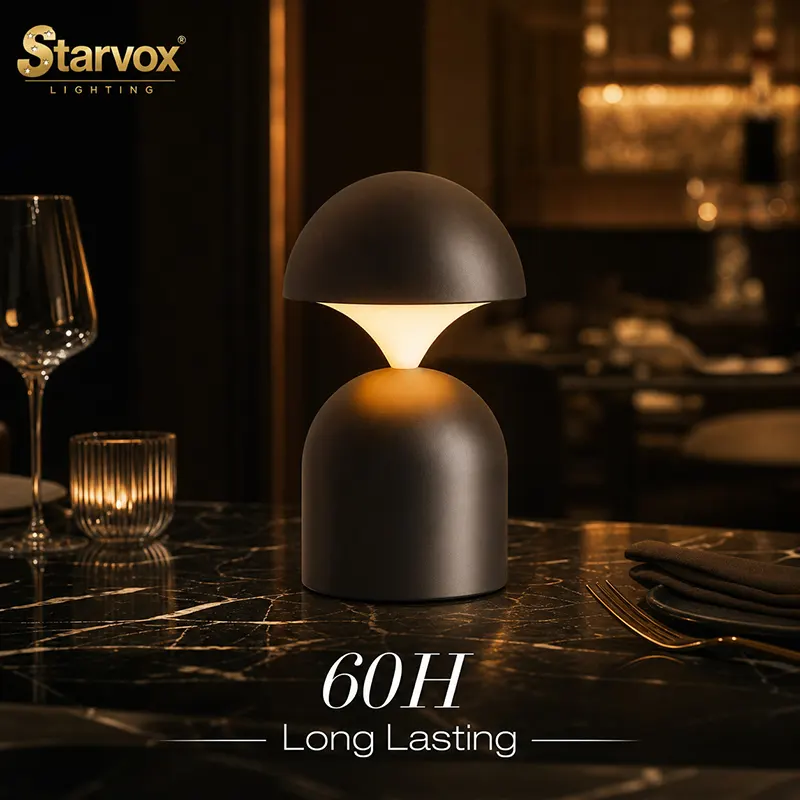
Consumer-grade cordless table lamp listings often advertise 2000mAh or 3000mAh batteries. Those numbers work for a living room where the lamp runs two hours per evening. They fail catastrophically in a restaurant where dinner service stretches from 5 PM to midnight, and Sunday brunch starts at 10 AM the next morning. A genuine 5000mAh lithium cell, paired with efficient LED drivers, delivers 60 hours of continuous illumination on a single charge. That is the difference between a manager who thinks about battery life as a daily checklist item and one who forgets battery life exists because it simply never runs out.
When evaluating a cordless table lamp, ask the supplier for the rated discharge curve. A manufacturer that has invested in battery testing will provide it. One that has not is likely sourcing consumer cells and inflating the numbers. A published 5000mAh with a documented discharge curve is a procurement signal. A listing that says “long battery life” without a number is a procurement red flag.
Waterproof Rating: IP65 vs IP44 and Why It Matters for Commercial Spaces
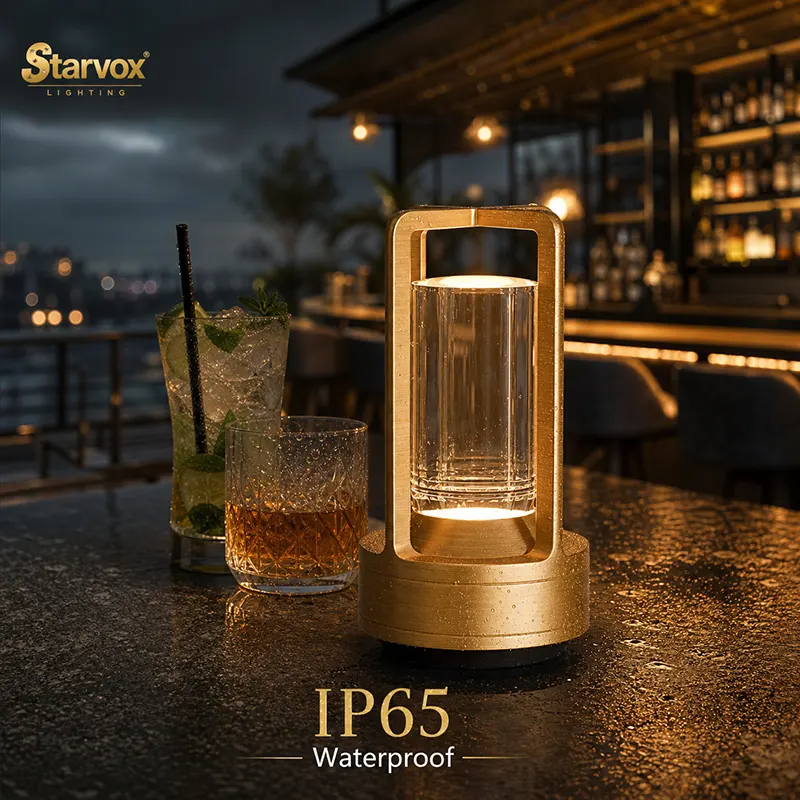
IP ratings are not interchangeable. IP44-rated cordless table lamp models resist splashing water but offer zero protection against dust ingress. On a coastal patio with salt-laden air, an IP44 lamp can develop internal corrosion within a single season. Dust enters through microscopic gaps. Salt accumulates on the battery terminals. The lamp dies quietly, often with no visible external damage, and the operator blames “cheap manufacturing” rather than understanding it was a rating mismatch.
IP65 means the lamp is fully dust-tight and protected against low-pressure water jets from any direction. For a restaurant that hoses down its patio at the end of the night, or a hotel poolside where lamps catch splash and spray all day, IP65 is the minimum practical rating. For venues within a mile of saltwater, it is non-negotiable. Ask your supplier whether the IP rating was tested by an accredited third-party laboratory. A claim without a lab report is a claim without evidence.
Build Material: Metal Housing vs Plastic and the Real Cost of Looking Cheap
A cordless table lamp with a plastic housing is lighter and cheaper to ship. It is also more likely to warp under the heat of a sustained LED driver, more likely to crack when a server bumps it off a table, and more likely to develop a scratched, chalky surface after six months of commercial use. In a fine-dining venue charging $80 per entree, a plastic lamp on the table undermines the pricing in a way that no menu redesign can fix.
Metal housings serve three functions that plastic cannot match. First, they act as passive heat sinks, drawing thermal energy away from the battery and LED driver and extending component lifespan. Second, they develop a patina rather than degrading; a brass lamp on year three looks more intentional than it did on day one. Third, they signal permanence. A metal lamp tells the guest this venue invested in its ambiance. A plastic lamp tells the guest the venue is cutting corners, and the guest starts looking for where else the corners were cut.
Charging System: Individual USB vs Bulk Inductive Docking
The charging architecture of a cordless table lamp deployment determines labor cost more than any other factor. Individual USB charging means a staff member must locate each lamp, find its charging port, connect a cable, and repeat 36 times. At 30 seconds per lamp, that is 18 minutes of paid labor every single night. Over a year, a restaurant spending $18 per hour on staff time burns approximately $1,971 on the act of plugging in lamps.
A bulk inductive charging system eliminates the cable entirely. Each lamp docks onto a trolley via induction. The trolley charges the entire fleet simultaneously in under 5 minutes. One staff member rolls the trolley out, distributes fully charged lamps, and the dining area is ready. The labor cost drops from $1,971 per year to approximately $197 per year. For a multi-venue hospitality group operating 5 locations, that single workflow recovery represents nearly $9,000 in annual labor savings on lamp management alone.
US Logistics: Why Domestic Warehousing Matters More Than Unit Price
A cordless table lamp quoted at $42 per unit with 45-day sea freight from an overseas factory is not actually $42 per unit. It is $42 plus the cost of a restaurant opening without lamps for 6 weeks. It is $42 plus the cost of expedited air freight when the container is delayed. It is $42 plus the cost of answering to an owner who approved a $15,000 lighting budget and is now staring at empty tables.
Suppliers with US domestic warehousing deliver in 7 days, not 7 weeks. They hold commercial inventory in-country, which means the procurement manager can order 36 lamps for a new venue opening next month and receive them before the soft launch. This capability is not a convenience. It is a procurement requirement for any project with a hard opening date. Verify that your supplier can deliver from US stock, not from a container that has not cleared customs.
Certification: CE, UL, and FCC as Procurement Gatekeepers
Commercial cordless table lamp procurement in North America requires three certifications at minimum. CE confirms conformity with European health, safety, and environmental standards. UL certifies that the product has been tested by Underwriters Laboratories for fire and electrical safety as verified by UL Solutions. FCC verifies that the lamp does not emit electromagnetic interference that could disrupt other equipment. A supplier that cannot produce these three documents on request is a supplier that has not invested in compliance. In the event of a fire investigation or insurance claim involving electrical equipment, the absence of UL certification shifts liability directly onto the venue owner. That is not a risk worth trading for a lower per-unit price.
How to Choose the Right Cordless Table Lamp Supplier
The market for cordless table lamp products now spans consumer resellers drop-shipping from overseas marketplaces, mid-tier importers rebranding generic designs, and a small number of hospitality-grade manufacturers with dedicated commercial engineering teams. Separating them requires four questions. Does the supplier offer a published battery specification with a rated discharge curve? Is the IP rating certified by a third-party laboratory? Does the supplier maintain US-based commercial inventory for 7-day delivery? Does the supplier provide CE, UL, and FCC documentation on request? Four yes answers identify a hospitality-grade partner. Fewer than four indicate a risk that the lamps will arrive late, fail early, or both.
A cordless table lamp is not décor. It is a commercial tool that either protects a restaurant reputation or erodes it one dead battery at a time. Choose with the same rigor applied to kitchen equipment, point-of-sale systems, and everything else that has to work every night without apology.
At the upper end of the market, luxury cordless table lamps carry their own specification bar. Our dedicated guide explains what separates boutique-hotel-grade hardware from the rest, and how to verify it before you commit.
When planning a full lighting upgrade, consider how your rechargeable cordless table lamps fit into a larger system with bulk charging trolleys and remote dimming. The right fleet does more than look good—it cuts nightly labor by 80% or more.
For a deeper dive into quality assessment criteria, see our commercial cordless table lamp quality evaluation guide.
4 thoughts on “The Proven Guide to Cordless Table Lamps: Battery, Waterproofing & Build Quality”