These restaurant patio lighting ideas work because they respect three layers — overhead ambient, table-level task, and perimeter accent — and the layer most operators get wrong is the one sitting on the table. String lights set the mood; but the light guests actually eat, read menus, and take photos under comes from table-level fixtures, and that is where weather damage and nightly labor costs pile up.
- What Does a Well-Lighted Patio Actually Need?
- Which Lighting Layers Belong Overhead?
- What Belongs at Table Level — and Why Candles Keep Losing?
- How Weatherproof Does Patio Lighting Need to Be?
- What Does Patio Lighting Really Cost to Run Nightly?
- How Do You Roll Out Patio Lighting Across Multiple Locations?
- Frequently Asked Questions
- The Short Version of These Restaurant Patio Lighting Ideas
This guide covers the design layers, the weatherproofing specifications that decide whether fixtures survive a season, and the operating math — the part most restaurant patio lighting articles leave out, and the part that decides whether your lighting plan pays for itself.
What Does a Well-Lighted Patio Actually Need?
A functional restaurant patio lighting plan uses three coordinated layers, each doing a different job. Ambient lighting provides the general glow that lets guests move safely and defines the space at night — string lights, pergola fixtures, or overhead lanterns. Task lighting sits at the table and makes menus readable, food photogenic, and faces visible across the table; it is the layer guests interact with all evening. Accent lighting draws attention to architectural features, landscaping, or your signage, and pulls in passersby from the street.
The common restaurant patio lighting failure mode is investing everything in the ambient layer — a beautiful canopy of Edison bulbs — and then putting a blown-out candle or a phone flashlight at the table. Guests experience the table layer for the entire meal. Under-invest there, and the overhead spectacle cannot compensate.
Rule of thumb: budget roughly as much for table-level lighting as for the overhead layer. A 30-seat patio typically needs ambient coverage across the full space, but only needs a well-chosen table fixture for each dining position — which makes the table layer the one you can upgrade incrementally, location by location.
Which Lighting Layers Belong Overhead?
String lights remain the default for good reason: they photograph well, they are visible from the street, and they define the space. Hang them with slight slack between anchor points, secure against wind gusts, and keep clear of headroom. Pergola or canopy fixtures give more structure and work well where the patio needs a defined ceiling plane. Wall-mounted sconces and uplighting on the building facade or landscape features handle the accent layer and make the venue findable from across the street.
Two overhead considerations operators skip:
- Glare control. Exposed bulbs at eye level from a seated position create glare and squinting photos. Suspend strings at least 2.2 m above dining surfaces, and prefer fixtures with some shielding over bare filaments directly above tables.
- Circuit planning. Overhead lighting on one circuit means one tripped breaker darkens the whole patio. Split ambient lighting across at least two circuits, and keep the table-level layer independent — if a storm forces you to kill the overhead lights, table lamps let you keep serving.
What Belongs at Table Level — and Why Candles Keep Losing?
The table level of your restaurant patio lighting is where three problems concentrate: wind, labor, and consistency.
Open-flame candles are the traditional answer and the worst operational one. Flame blows out in gusts, wax lands on linens, most jurisdictions restrict or ban open flame on patios, and servers spend the evening relighting wicks. Flameless LED candles fix the flame problem but run on small cells that die mid-service — someone is swapping or charging them daily, and a dead candle reads as neglect from two tables away.
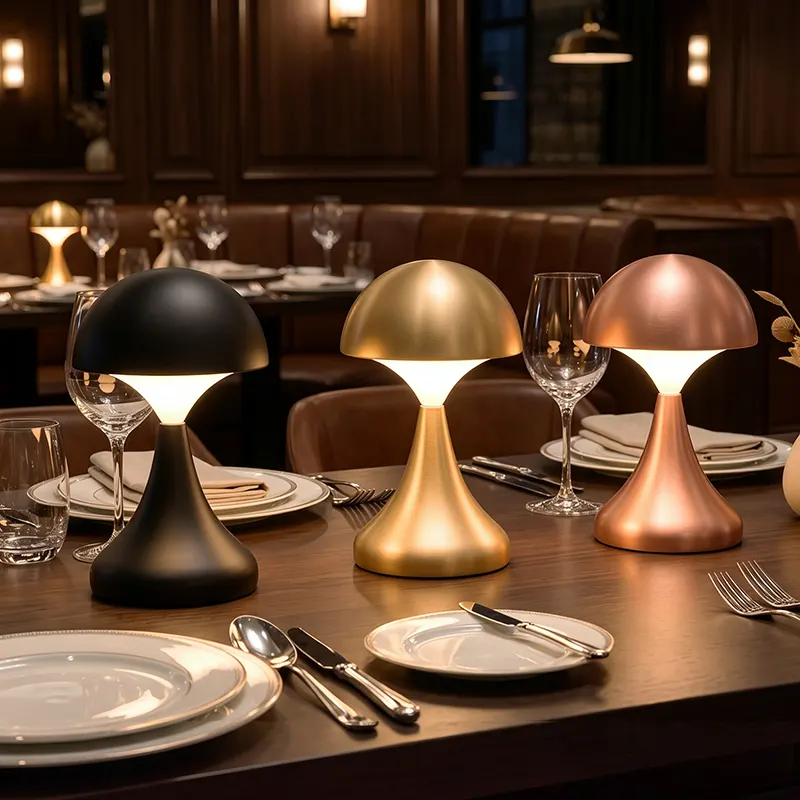
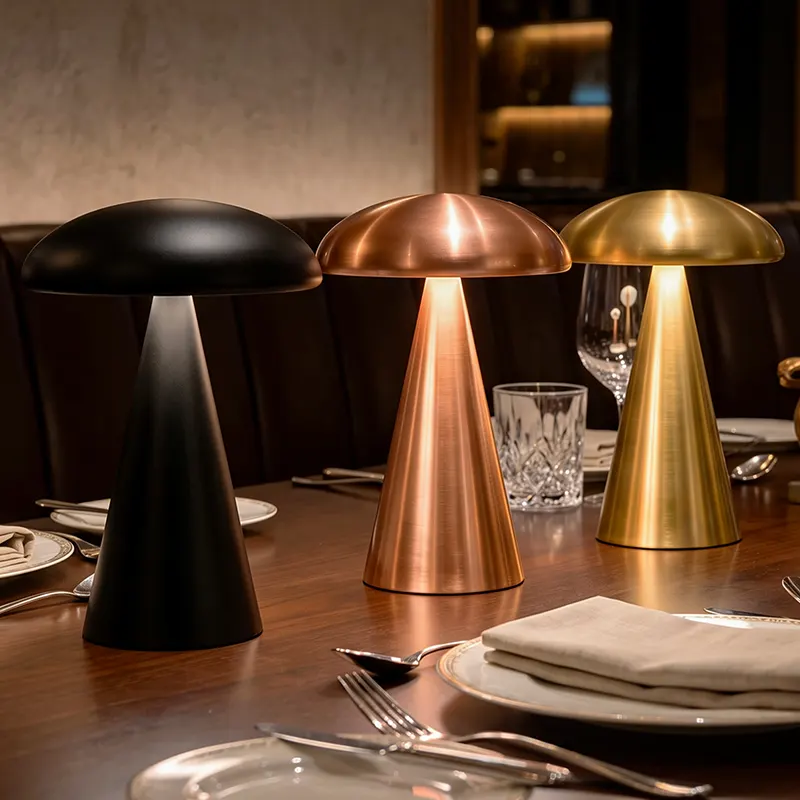
The stronger option for full-service patios is the commercial cordless table lamp: a rechargeable fixture designed to sit at the guest’s table all evening. What separates hospitality-grade units from decorative ones is worth specifying explicitly:
- Battery capacity and runtime. A real service night runs 6–8 hours. A 5000 mAh-class lithium cell delivering 60+ hours of output per charge means the lamp covers multiple services, not one — the difference between charging every night and twice a week.
- Weather rating. Outdoor tables need IP65-class sealing against rain and wind-driven moisture, not the IP54 “splash-resistant” rating that indoor-grade lamps carry. Coastal patios add salt air to the test, which is where metal housings with corrosion-resistant finishes outlast plastic — plastic yellows, clouds, and cracks within a season or two.
- Design weight. The lamp is part of every guest photo. Sculpted metal bodies with classic European silhouettes — the design language Starvox builds with our French design team — read as part of the dining experience rather than as equipment.
And then there is the layer most guides never price in: what happens to thirty lamps at close. Cordless lamps solve the flame and outlet problems, but every rechargeable fixture still has to get collected, plugged in, and put back before the next service. Collected lamp by lamp, across a 30-table patio, that ritual costs an hour or two of staff time every night.
This is the problem our charging system was engineered around: instead of touching each lamp individually, staff roll a 5-minute charging trolley through the patio, slot the lamps in, and wheel them back charged. Standardized across a patio, the workflow cuts more than 80% of the daily lamp-handling labor compared with one-by-one charging. For a multi-patio operation, that labor delta is the entire business case for standardizing on one lamp platform.
How Weatherproof Does Patio Lighting Need to Be?
Ingress protection ratings decide whether restaurant patio lighting survives the season, and the numbers are worth knowing:
- IP54 — protected against splashing water. Acceptable for covered patios and briefly damp environments; marginal for open patios where wind drives rain sideways.
- IP65 — sealed against water jets from any direction. The correct minimum for open-air dining in real weather, and the rating we build into Starvox outdoor lamps.
Beyond the rating, three material questions:
- Housing material. Metal housings (aluminum, stainless) with corrosion-resistant finishes handle salt air and UV exposure; plastic housings are lighter and cheaper but yellow, haze, and become brittle outdoors.
- Sealed charging ports. The charging interface is where water enters. Magnetic or port-covered designs protect the failure point.
- Certification for the market. Fixtures for US patios should carry UL or FCC documentation; CE covers European deployments. Certification is also what your insurance company and your landlord will ask about after the first storm.
The ingress protection numbers above come from the IEC 60529 standard — the IP code reference lists the full classification table if you want to verify a supplier rating.
What Does Patio Lighting Really Cost to Run Nightly?
Here is the arithmetic worth doing before buying any restaurant patio lighting, using a 30-table patio as the model:
| Cost line | Candle / flameless route | Cordless lamp route (single-lamp charging) | Cordless lamp + charging trolley |
|---|---|---|---|
| Nightly consumables | Candles or LED cell replacements, continuous | None | None |
| Staff time at close | Relighting, wax cleanup | Collect + plug in 30 lamps: ~1–2 hours | Roll trolley: ~5 minutes |
| Replacement cycle | Candles weekly; cheap LED candles quarterly | Lamps last years; batteries 500+ cycles | Same, batteries charged in place |
| Guest-visible failures | Blown-out flames, dead candles mid-service | Occasional uncharged lamp | Rare — fleet charges in one pass |
The line operators underestimate is staff time. An hour of nightly lamp handling is roughly 30 hours a month — a near-full-time week of labor spent walking batteries around. Aggregated across a season, that single line item usually exceeds the cost of the lamps themselves, which is why the charging-trolley model pays back fastest on patios with high table counts.
How Do You Roll Out Patio Lighting Across Multiple Locations?
Single-location operators can buy whatever restaurant patio lighting works. Groups rolling out across 5, 10, or 40 patios need procurement discipline, and this is where supplier selection matters more than design taste:
- MOQ that matches a pilot. A 36-piece minimum order lets a group pilot one patio before committing fleet-wide. Suppliers demanding container-scale commitments are forcing you to skip the pilot.
- US-based inventory. Stocked product shipping within 7 days nationwide means a patio opening next month is not hostage to an overseas production run. All Starvox units ship from US stock with that lead time.
- Documented compliance. CE, UL, and FCC documentation should arrive with the quote, not after the audit request. Our supply chain is a long-standing Sam’s Club direct supplier with an official Walmart ID, which is the compliance pedigree chain procurement teams screen for.
- After-sales that answers. A 12-month warranty means little if the supplier is a trading company three time zones away. Confirm who handles a failed unit in month eleven.
- One platform, consistent look. Locations with different lamp models photograph inconsistently and train staff inconsistently. Standardize the platform, vary only finishes.
Frequently Asked Questions
What are the best restaurant patio lighting ideas?
A three-layer system: overhead string or canopy lights for ambient mood, a quality table-level lamp for task light at each dining position, and accent lighting on the facade or landscape. The table layer is where guests spend the evening, so under-specifying it undermines the rest.
Are cordless table lamps suitable for outdoor patios?
Only if they carry a genuine IP65 rating and a corrosion-resistant metal housing. Indoor-grade rechargeable lamps (IP54 or unrated) fail within a season outdoors. Check the ingress protection, the battery runtime per charge, and whether the charging port is sealed.
How do you keep table lamps charged without annoying the staff?
Standardize on one lamp platform and use a batch charging trolley. Rolling collection charges a 30-lamp patio in about five minutes instead of an hour or two of individual plugging in, and it eliminates the lamp that someone forgot to charge.
How long do rechargeable patio table lamps run per charge?
Hospitality-grade units with 5000 mAh-class batteries deliver 60+ hours — several full dinner services — before recharging. Decorative lamps with small cells often fade mid-service, which is exactly the failure guests notice.
What should a chain look for when buying patio lighting at scale?
A 36-piece-class minimum order for piloting, US stock with 7-day shipping, CE/UL/FCC documentation included with the quote, a 12-month warranty backed by the actual manufacturer, and one consistent lamp platform across locations.
The Short Version of These Restaurant Patio Lighting Ideas
Get the overhead layer right with string lights and structure, then put your real budget and your real standards at the table: IP65-sealed metal lamps with all-night batteries, on a charging system your staff can reset in five minutes. The patio is the highest-margin square footage your restaurant has for half the year — light it like the revenue depends on it, because it does.
Planning a patio refresh or a multi-location rollout? Talk to our team about Starvox cordless table lamps and the 5-minute charging trolley — 36-piece MOQ, US stock, 7-day delivery. Reach us through the contact page for a same-week quotation.
Related reading: weighing the switch? See our cordless vs wired table lamps comparison — it adds USD install-cost math, honest wired cases and charging logistics at scale.