The cordless vs wired table lamps decision is one most US restaurant operators rush, and the rush usually costs money. On five of the six factors that decide daily operating cost, cordless table lamps beat wired: installation, layout flexibility, outdoor use, reset speed and power-outage resilience. Wired lamps keep two genuine advantages, fixed banquettes that never move and venues with no charging window between services. A 30-table dining room typically spends $6,500 to $15,000 wiring wired lamps into the floor, against $1,700 to $3,200 placing commercial cordless units and a charging trolley on the same tables. This guide runs the honest numbers in US dollars, shows where wired still wins, and explains the charging logistics that most cordless pitches skip.
- What Actually Differs Between Cordless and Wired Table Lamps?
- What Does Each Option Really Cost a US Restaurant?
- When Does Wired Still Win?
- How Do Charging Logistics Actually Work at Scale?
- Which Option Survives Outdoor and Seasonal Seating?
- What Should You Check Before Signing a Purchase Order?
- Our Verdict for US Restaurant Operators
- Frequently Asked Questions
What Actually Differs Between Cordless and Wired Table Lamps?
A cordless table lamp carries its own rechargeable battery, charges on a base or trolley between services, and moves with the table. A wired lamp draws continuous power through an outlet, which means every table position needs a floor box, conduit or cable run before the first lamp is ever switched on. For a restaurant, that single infrastructure difference cascades into everything: where tables can sit, how fast the floor resets between covers, whether the patio gets lighting at all, and what happens to the room’s mood when the power flickers mid-service.
The lamp price difference is small and often favors wired units at the low end. The installed cost difference is not small, and it lands entirely on the wired side. That is why the comparison that matters is never lamp versus lamp; it is lamp plus infrastructure versus lamp plus charging.
There is a guest-side difference too. Wired rooms drift: different bulb ages and replacement rounds leave one table at 2700K and its neighbor at 3200K, and nobody notices until a guest photographs the two tables side by side. Commercial cordless fleets ship from one production batch with calibrated LEDs, so table three and table thirty glow identically. On a floor where guests photograph their plates, that consistency is worth something you cannot invoice separately.

What Does Each Option Really Cost a US Restaurant?
Sticker prices mislead, so price the whole job. Using a typical 30-table dining room and standard US commercial electrician rates:
| Cost item | Wired (30 tables) | Cordless (30 tables) |
|---|---|---|
| Lamps | $1,800 to $3,600 ($60-120 each) | $1,350 to $2,550 ($45-85 each) |
| Floor outlets, installed | $4,500 to $10,500 ($150-350 each) | $0 |
| Permits and inspection | $200 to $800 | $0 |
| Charging system | $0 | $350 to $650 (trolley plus bases) |
| Electrician labor | Included above | $0 |
| Typical total | $6,500 to $14,900 | $1,700 to $3,200 |
Two caveats keep this cordless vs wired table lamps math honest. First, local electrician rates swing the wired column hard; dense urban markets with permit requirements sit at the top of the range. Second, cordless lamps are consumables in a way wired fixtures are not: commercial batteries hold 500 or more charge cycles, so plan on refreshing a portion of the fleet every two to three years. Even adding a battery refresh reserve, the cordless total rarely reaches half of the wired total in year one. Ask for quotes reflecting your actual table count before committing to either column.
When Does Wired Still Win?
Cordless advocacy fails when it pretends wired has no use case. Two situations justify wired lamps in the cordless vs wired table lamps debate, and pretending otherwise costs credibility:
- Fixed banquettes and built-in booth seating. If the table will never move and the outlet already exists in the base, a wired lamp is set-and-forget. There is no charging routine and nothing to forget on a Saturday night.
- Near-continuous operation with no charging window. A 24-hour diner or a venue running lunch through late night with no gap cannot rotate lamps through a charge cycle unless it buys a spare fleet. If buying doubles the fleet, wired infrastructure may pencil out.
Everything else, patios, seasonal layouts, private dining rooms, rooftop events and any room where the furniture moves for a party of twelve, belongs to cordless. The test is simple: if the table moves or the power does not reach it, wired loses.
How Do Charging Logistics Actually Work at Scale?
The first question every skeptical operator asks about the cordless vs wired table lamps math is the right one: where do sixty lamps charge, and who moves them? Good cordless systems answer with a routine, not a hope.
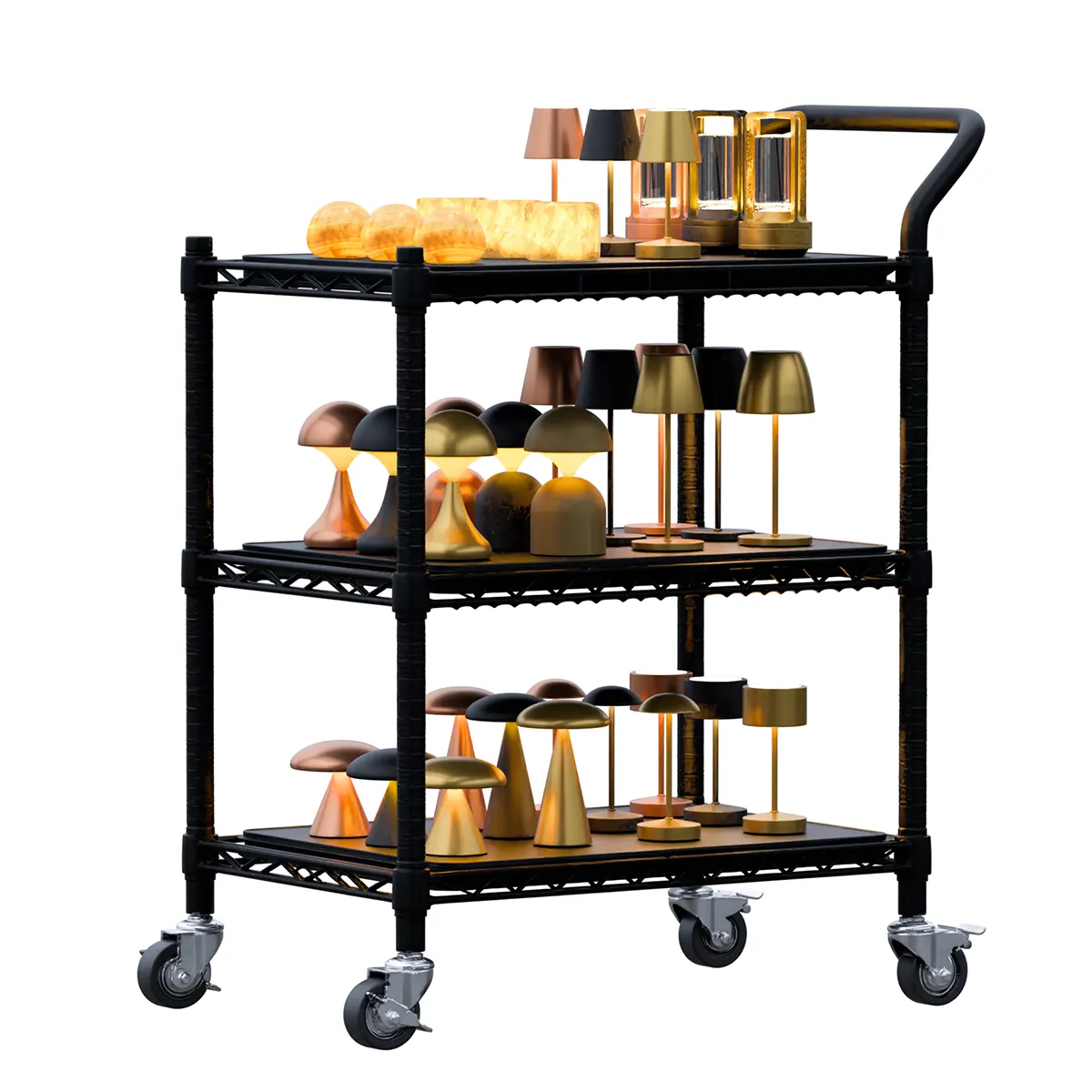
The failure mode is treating charging as a dishwashing task, lamps scattered across a back counter on random pads, some missed, some dead at Friday peak. The working pattern is a dedicated charging trolley: servers roll it through the dining room at close, lamps dock in place, and the whole fleet charges overnight in one pass. With hospitality-grade units carrying 5000 mAh batteries, a full charge delivers 60 or more hours of runtime, so one overnight cycle covers multiple dinner services. Starvox’s 5-minute charging trolley cuts the labor to about 20% of what pad-by-pad charging takes, which is the difference between a three-minute close-down task and a fifteen-minute one.
A spare-fleet rotation covers the no-gap venues: run one set on the floor and keep the second charged. That doubles lamp spend, so compare it honestly against the wired infrastructure bill before deciding.
Which Option Survives Outdoor and Seasonal Seating?
In the wired half of the cordless vs wired table lamps decision, outdoor lighting means trenching, weather-rated conduit and permanent fixtures, which is why so many patios sit dim at dusk. Cordless units simply need the right ingress rating. IP65 seals out rain and wind-blown dust, so lamps live on open terraces through the season; IP44 handles covered patios only. Salt air is the other killer, coastal venues should confirm corrosion-resistant finishes before ordering. The deeper point in the cordless vs wired table lamps comparison for a multi-season operation: cordless lighting follows the seating. When the patio opens in April, the lamps move out; when the first frost comes, they move back in.
Wired lamps bolt the seasonal decision into the floor. Our restaurant patio lighting guide covers the full outdoor layering in detail.
What Should You Check Before Signing a Purchase Order?
Whether the quote is cordless or wired, these six checks protect the budget on either side of the cordless vs wired table lamps decision:
- Runtime at your brightness. Battery figures are quoted at medium or low setting. Test at the light level your dining room actually uses; high output can cut runtime by 40 to 60 percent.
- Ingress rating. IP65 for open-air terraces, IP44 minimum under cover.
- Safety certifications. UL, CE and FCC marks for the exact model, not a family of products.
- Charge cycle life. 500 cycles minimum for daily commercial use, with replacement batteries available.
- Charging system design. Trolley or dock, minutes per full cycle, and where it lives in your floor plan.
- Warranty and spares. Twelve months minimum on lamp and battery, with spare parts stocked in your country.
Our quality evaluation guide walks through each of these for cordless units specifically. For wired fixtures, add a seventh: a written quote for the outlet work before the lamp order, so the infrastructure number never surprises you at invoice time.
Our Verdict for US Restaurant Operators
Run honestly, the cordless vs wired table lamps comparison ends the same way for most US restaurants: cordless wins on total cost, flexibility and guest experience, and the gap widens every time the floor plan changes.
Start the cordless vs wired table lamps test with a 36-unit pilot on the highest-visibility section of the dining room, run it for two weeks of real service, and measure reset time before expanding. Operators who need US stock quickly can draw from domestic inventory with delivery in about seven days, which makes the pilot a two-week decision rather than a quarter-long project. Wired remains the right call for fixed banquettes with existing outlets and venues with no charging window, and this guide would be weaker if it pretended otherwise.
Frequently Asked Questions
Are cordless table lamps bright enough for restaurant dining?
Yes, when specified correctly. Commercial cordless lamps deliver warm 2700K to 3000K light designed for table-level ambiance rather than room illumination. Check lumen output and test at your intended brightness, because runtime figures assume medium settings.
How long do cordless table lamps last per charge?
Hospitality-grade units with 5000 mAh batteries run 60 or more hours at typical dining brightness, covering several dinner services per charge. Consumer-grade lamps rated 6 to 12 hours require nightly charging, which is why the charging system matters as much as the lamp.
Do cordless lamps work during a power outage?
Yes, and this is an underrated advantage. A restaurant lit by cordless table lamps keeps its mood and its service running through grid flickers that kill wired fixtures instantly, assuming the kitchen has its own contingency.
What is the typical payback period for switching from wired to cordless?
For a restaurant already planning electrical work, the cordless route avoids most of the $4,500 to $10,500 outlet installation on a 30-table room, so the switch pays back immediately at the point of decision. Retrofitting purely to escape working wired lamps takes longer and depends on how much the existing infrastructure cost.
How many spare lamps should a restaurant keep?
Plan on 10 to 15 percent of the fleet as charged spares for rotation, which covers breakage, a missed charge and banquets that stretch past a single service cycle.
Related reading: see how the same specs apply to premium service in our fine dining table lighting guide — seven specs, fleet consistency and the purchase-order checklist.