A Buyer’s Guide to IP54 Waterproof Cordless Restaurant Lamps
For procurement managers and owners of upscale outdoor dining venues, the “patio season” is the most profitable—and often the most frustrating—time of year. You invest in the ambiance, the menu, and the staff, but when it comes to table lighting, many venues fall into a costly, repetitive trap.
If you’ve noticed your table lamps flickering, yellowing, or simply refusing to charge after just one season on a coastal terrace, you aren’t alone. The hospitality industry is currently flooded with cheap, consumer-grade “waterproof” lamps that look great in a catalog but fail in the field.
In this guide, we’ll explore why outdoor waterproof cordless restaurant lights often fail, the science of coastal corrosion, and why moving from plastic to IP54-rated metal engineering is the only way to protect your ROI.
The Expensive Cycle of Replacing Outdoor Patio Lights Every Season
The math of “cheap” lighting is deceptively simple and ultimately punishing. Many restaurants start their outdoor season by purchasing $20-$30 plastic cordless lamps from retail marketplaces. On paper, it looks like a win for the budget.
However, by month three, the reality sets in:
1. Seal Failure: Rain and humidity penetrate the seams, causing short circuits.
2. UV Degradation: Plastic casings become brittle and yellow under the US sun.
3. Battery Decay: Heat exposure during the day degrades the lithium-ion cells, leading to lamps that can’t stay lit through a full dinner service.
By the time the season ends, a significant portion of the inventory is in the trash. When you factor in the labor cost of nightly charging, the replacement of broken units, and the loss of guest ambiance, that $30 lamp actually costs significantly more than a professional-grade alternative.
Why Coastal Air and Rain are the Enemies of Cheap Lighting
For venues located in Florida, California, or the Eastern Seaboard, the environment is a literal “metal eater.” Coastal air is thick with salt aerosols that are far more destructive than standard inland humidity.
The Science of Salt-Air Corrosion
According to atmospheric site data from NASA, corrosion rates in coastal environments can be up to 100 times higher than in inland rural areas. Salt (sodium chloride) is hygroscopic, meaning it attracts and holds moisture. When salt spray lands on a lamp, it creates a conductive electrolytic film that accelerates the oxidation of internal components.
Cheap outdoor waterproof cordless restaurant lights made of low-grade ABS plastic or thin aluminum alloys often lack the specialized powder coatings required to resist this process. Once the salt penetrates the charging port or the touch-sensor seam, the electronics begin to corrode from the inside out.
Condensation: The Silent Killer
It isn’t just the rain. The “diurnal cycle”—the shift from hot days to cool nights—creates condensation inside lamp housings. If a lamp isn’t properly vented or hermetically sealed, this internal moisture builds up over time, leading to “ghosting” (the lamp turning on/off by itself) and eventual battery failure.
Understanding IP54 Waterproof Rating for Outdoor Cordless Restaurant Lights
In the world of professional lighting, “waterproof” is a vague marketing term. The only metric that matters for procurement is the Ingress Protection (IP) rating.
For outdoor waterproof cordless restaurant lights, the industry standard for high-performance venues is IP54.
- The First Digit (5): This indicates protection against dust. In a hospitality setting, this means the lamp is protected against wind-blown debris, sand, and pollen that can clog charging ports and mechanical switches.
- The Second Digit (4): This indicates protection against “water splashing from any angle.”
Why IP54 is the “Sweet Spot” for Hospitality
While some manufacturers claim IP65 (protection against water jets), IP54 is specifically engineered for the realities of table service. An IP54 lamp is designed to withstand a sudden thunderstorm, the accidental spill of a glass of wine, and the daily “wipe-down” with commercial cleaning agents.
Crucially, IP54 engineering ensures that the lamp remains “breathable” enough to manage heat dissipation from the battery while keeping harmful moisture out of the delicate LED driver circuits.
Water Splashes, Dust, and Wind: The Reality of Hospitality Use
A patio lamp isn’t just sitting there; it’s a tool in a high-velocity environment.
1. The “Splash” Factor
In a busy restaurant, spills are inevitable. Whether it’s a condensation-heavy cocktail or a spilled pitcher of water, the lamp is in the “splash zone.” A retail-grade lamp with a simple rubber plug over the USB port will eventually fail when a server forgets to replace that plug after charging.
2. High Winds and Tip-Overs
Outdoor dining often involves wind. Cheap plastic lamps are lightweight, making them prone to blowing off tables. Even a 3-foot drop onto a stone patio can crack the housing of a plastic lamp, immediately voiding its waterproof integrity. Professional outdoor waterproof cordless restaurant lights utilize weighted metal bases to lower the center of gravity, ensuring they stay put during a 20-knot breeze.
3. Cleaning Protocols
The National Fire Protection Association (NFPA) and various hospitality safety standards emphasize the importance of sanitized surfaces. Commercial lamps must be able to withstand daily exposure to isopropyl alcohol or quaternary ammonium sanitizers without the finish peeling or the seals degrading.
Metal vs. Plastic: The Investment Choice for ROI
When choosing outdoor waterproof cordless restaurant lights, the material of the body is the primary indicator of lifespan.
The Problem with Plastic
Plastic (ABS or Polycarbonate) is an insulator. While it’s cheap to manufacture, it traps heat. During the US summer, an outdoor table can reach temperatures exceeding 100°F. Lithium-ion batteries degrade rapidly when they cannot shed heat. Furthermore, plastic is porous at a microscopic level, allowing “wicking” of moisture over time.
The Metal Collection Advantage
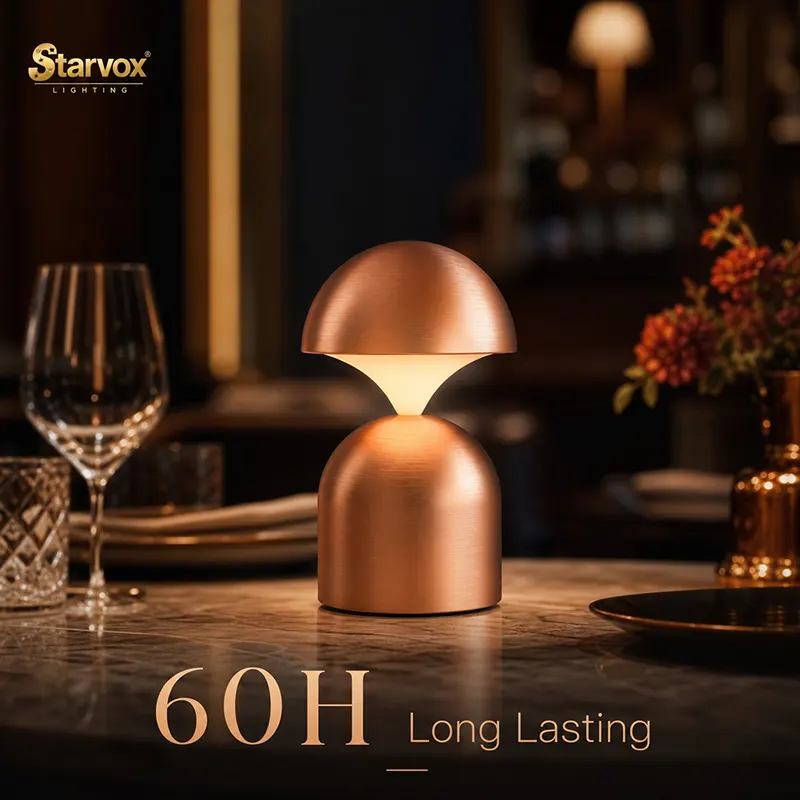
Professional fixtures, such as those found in the Starvox Metal Collection, are built from die-cast aluminum or heavy-duty alloys.
* Heat Dissipation: Metal acts as a natural heat sink, pulling heat away from the battery and LED chip, which extends the lamp’s functional life by years.
* Durability: Metal doesn’t yellow or crack. A scratched metal lamp can be refinished; a cracked plastic lamp must be replaced.
* Aesthetic Weight: For upscale venues, the “hand-feel” of a metal lamp signals quality to the guest. It feels like a permanent architectural fixture rather than a temporary toy.
Battery Life in the Elements: 12-Hour Reliability
For a restaurant, a lamp that dies at 9:00 PM is worse than no lamp at all. It disrupts the guest experience and forces staff to scramble for replacements mid-service.
Outdoor conditions place a heavy load on batteries. Cold nights can sap capacity, while hot days increase internal resistance. High-quality outdoor waterproof cordless restaurant lights are designed with “over-capacity” battery modules. If you need 8 hours of light, you should buy a lamp rated for 12-15 hours. This ensures that even as the battery naturally degrades over 500+ charge cycles, it will still comfortably last through your longest Friday night shift.
At Starvox, we focus on eliminating the “Nightly Charging Trap”—the labor-intensive process of moving lamps in and out. By using high-density cells and efficient LED drivers, our lamps maintain consistent brightness from the first course to the last digestif.
Starvox Engineering: Built for the US Patio Season
Starvox was founded on a simple premise: commercial lighting should be an asset, not a consumable. Our engineering approach for outdoor waterproof cordless restaurant lights focuses on three pillars of durability:
1. Modular “Serviceable” Design
Most cordless lamps are “glued shut.” If the battery dies or a guest breaks the charging port, the whole lamp is e-waste. Starvox solutions are modular. We believe that hospitality managers should be able to replace a battery module or an LED engine in 60 seconds, extending the life of the fixture indefinitely.
2. Verified IP54 Sealing
We don’t just put an IP54 sticker on the box. Our fixtures undergo rigorous testing for salt-spray resistance and water ingress. We utilize high-grade silicone gaskets and recessed charging ports to ensure that the “outdoor” in our name is a promise, not a suggestion.
3. Architecture-First Optics
Outdoor lighting shouldn’t just be “bright.” It needs to be warm (2700K) and glare-free. Our lamps use custom-engineered diffusers that throw light down onto the table surface—where the food and wine are—rather than up into the guests’ eyes.
Conclusion: Invest in Waterproof Cordless Restaurant Lights That Last
The cycle of buying, breaking, and disposing of cheap patio lights is a drain on your venue’s finances and the environment. By investing in high-quality outdoor waterproof cordless restaurant lights with a true IP54 rating and metal construction, you are securing the ambiance of your venue for years to come.
Your patio is an extension of your brand. Don’t let flickering, corroded plastic lamps tell the wrong story to your guests.
Ready to upgrade your outdoor dining experience?
Explore the Starvox Metal Collection or contact our procurement team for a custom hospitality solution tailored to your venue’s specific climate needs.
Frequently Asked Questions
1. Is IP54 enough for a coastal restaurant?
Yes, provided the lamp is made of corrosion-resistant materials like die-cast aluminum with a high-quality powder coat. The IP rating covers water ingress; the material choice covers salt-air survival.
2. How long should a professional cordless lamp last?
With proper care and a modular design, the “body” of the lamp should last 5-10 years. The battery module typically needs replacement every 2-3 years depending on usage.
3. Can I leave these lamps out in the rain?
IP54-rated lamps are designed to withstand rain. However, for maximum longevity, we recommend bringing them in for charging during extreme weather events or hurricanes.
4. Why is metal better than plastic for the US sun?
Plastic undergoes UV degradation (photodegradation), which breaks down the polymer chains, causing it to become brittle. Metal is impervious to UV damage.
Authoritative Sources:
* NASA Corrosion Technology Laboratory: Coastal Atmospheric Data.
* National Fire Protection Association (NFPA): Safety Standards for Portable Electrical Appliances.
* NOAA National Ocean Service: Impacts of Salt Spray on Infrastructure.
6 thoughts on “Why Your Patio Lights Die Every 3 Months: A Buyer’s Guide to IP54 Waterproof Cordless Restaurant Lamps”