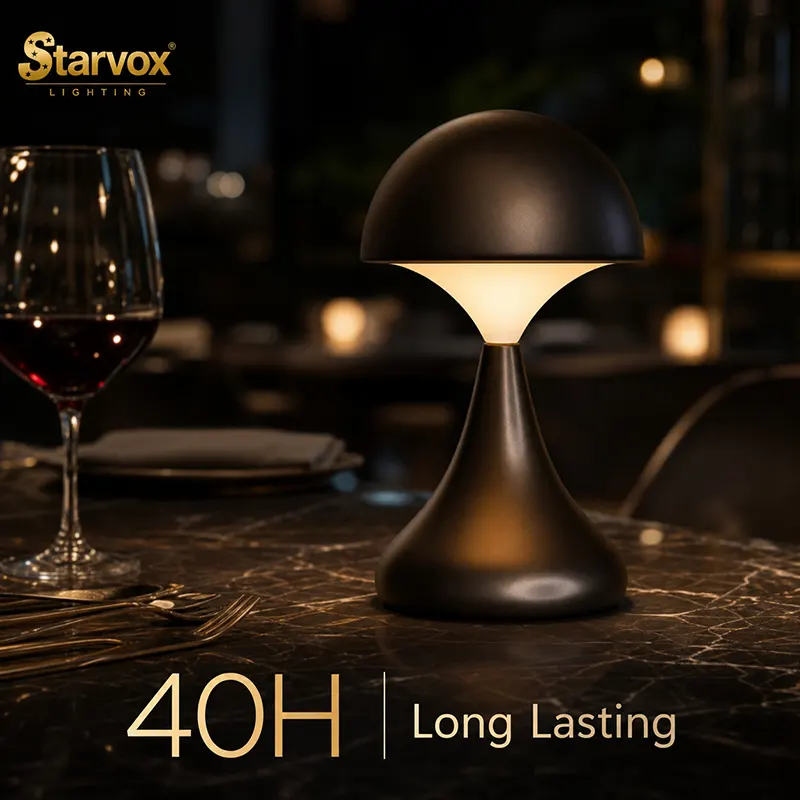
A portable table lamp can be the difference between a flexible dining space and one tethered to wall outlets. For restaurant and hotel operators, the question is never whether you need portable lighting—it is which unit will actually hold up through nightly moves, outdoor service, and staff who do not have time to handle fragile fixtures carefully.
After ten years of supplying cordless lighting to European hospitality groups, we have seen every kind of portable lamp deployment succeed and fail. This guide covers what actually matters when you are buying for a commercial property—not for a living room.
- Weight and Build: The Hidden Cost of Light Fixtures
- Battery Life That Matches Your Service Hours
- Charging Workflows: Docks, Trolleys, and Staff Time
- Outdoor Use: What Portable Lamps Actually Survive
- The Real Cost of Cheap Portable Lamps
- How to Pick the Right Portable Lamp for Your Property
- Frequently Asked Questions
Weight and Build: The Hidden Cost of Light Fixtures
Lighter is not always better. A lamp so light that it tips over when a guest reaches for a water glass is not portable—it is disposable. The right weight for a commercial portable table lamp is enough to feel stable on a windy patio, but not so much that staff struggle carrying four at once.
Machined aluminum and brass bodies hit this balance naturally. Our CT-0820 weighs under 400 grams with a low center of gravity, which is why staff at partner restaurants carry them by the dozen during table resets without complaint. Cheap plastic units weigh half as much and blow over in a stiff breeze on the patio.
Build quality also determines how many moves a lamp survives. Threads strip on cheap bases. Plastic housings crack when set down too hard. A metal body with quality machining costs more on the purchase order and costs less every year after that. Our metal vs. plastic commercial lamp comparison covers this in detail. more on the purchase order and costs less every year after that.
Battery Life That Matches Your Service Hours
Battery capacity numbers on spec sheets are mostly marketing. The real question is whether the lamp makes it through your longest service without dying at a table mid-dinner.
For most restaurants, that means 6 to 8 hours of runtime at the brightness level you actually use—not the dimmest setting. A 2000mAh cell in a small portable unit runs roughly 12 to 16 hours on low but only 4 to 6 on full. A 5000mAh cell in a slightly larger body, like our Vintage or Dome series, runs 60+ hours at restaurant brightness.
Match the battery size to your usage pattern. A cocktail bar that needs six hours of ambient light does not need the same cell as a resort pool deck running twelve-hour service. Ask suppliers for a runtime test at 75% brightness, not the headline figure.
Charging Workflows: Docks, Trolleys, and Staff Time
The operational side of portable lamps is where most properties get it wrong. You buy the lamps, set up a charging shelf in the back office, and then discover that collecting and docking forty units every night takes one person ninety minutes.
Individual USB charging is fine for five or ten lamps. It does not scale. Cables tangle. Ports corrode from drink spills that somehow always find the charging station. Someone has to match each lamp to its own charger, which sounds trivial until it is midnight and the closing shift wants to go home.
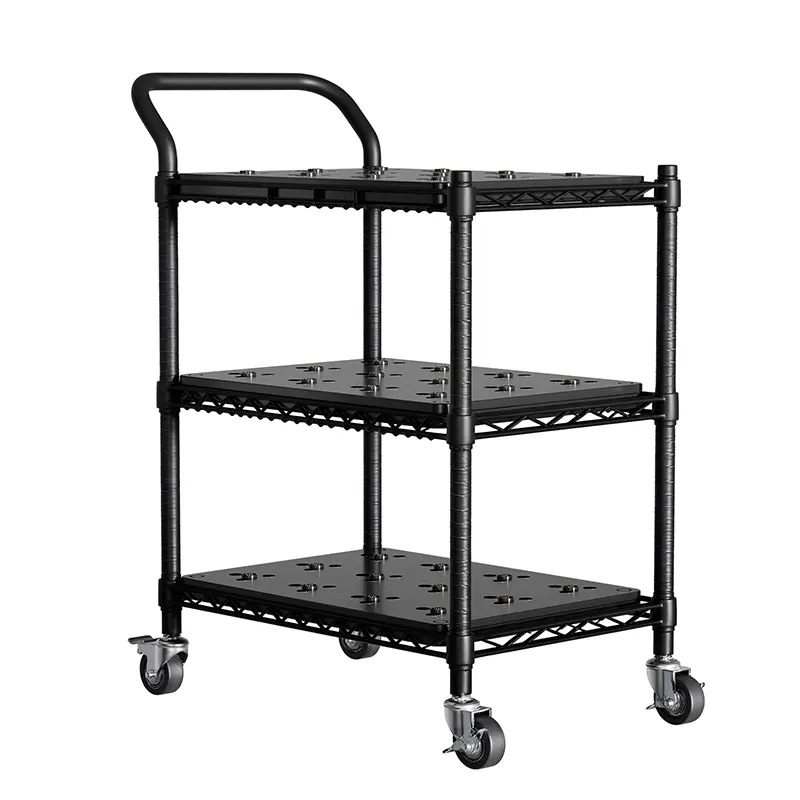
A contact charging trolley changes the whole workflow. Wheel it through the dining room, set each lamp into its dock in one pass, and roll it back to storage. The full fleet is charged within five hours. We measured this at partner restaurants: nightly handling time dropped from an average of 72 minutes per night to 5 minutes across our partner restaurant locations — an 84% reduction.
That is the math that matters. If you are evaluating a portable table lamp fleet, calculate the labor cost of the charging routine before you compare unit prices. The cheapest lamp on the quote is rarely the cheapest one to operate. Explore our inductive charging system if you want to see how the trolley model works in practice.
Outdoor Use: What Portable Lamps Actually Survive
Any lamp marketed as portable will claim it works outdoors. Few actually survive a season of patio service. Rain, spilled drinks, salt air, and pressure-washed floors will destroy anything that is not properly rated.
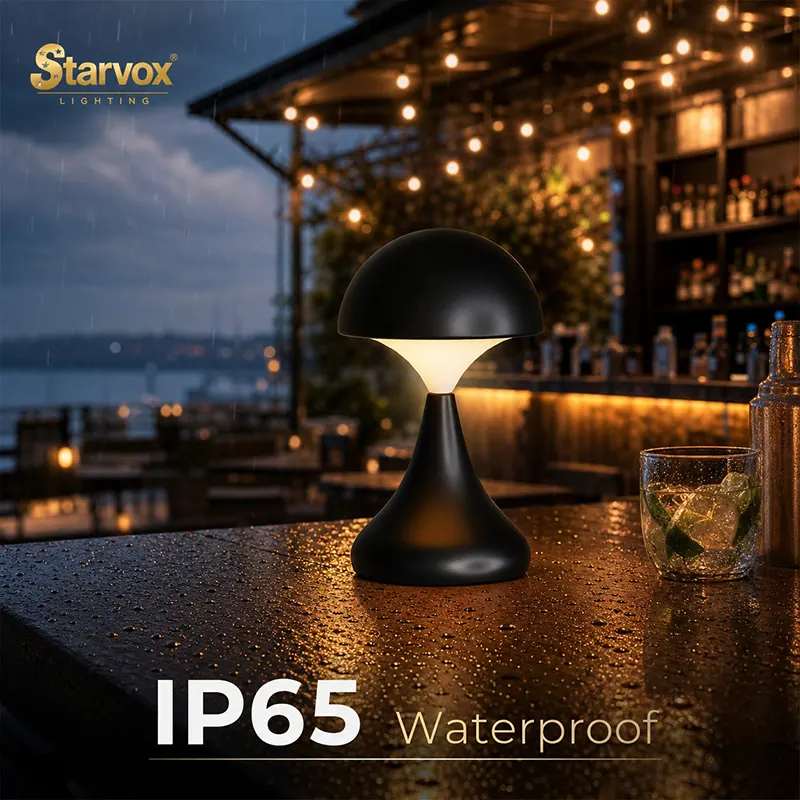
IP54 is splash resistance. It means a few drops of rain will not kill the lamp. It is not enough for regular outdoor use. IP65 is the practical minimum for commercial patio service. For a deeper breakdown, read our IP54 vs IP65 waterproof guide for outdoor dining. IP65 is the practical minimum for commercial patio service: dust-tight and protected against low-pressure water jets from any direction.
Coastal properties need an extra layer. The polyester powder coating on our outdoor-rated units is applied at 80 to 100 microns and tested to ISO 9227 neutral salt spray for over 1,000 hours. A fixture without that level of coating will show corrosion within a single season near the ocean. Our IP54 vs IP65 guide breaks down the engineering differences in detail.
The Real Cost of Cheap Portable Table Lamps
Let us run the numbers on a typical 40-lamp restaurant deployment. This is not theoretical—it is what we see when operators switch from consumer-grade fixtures to commercial ones.
| Individual USB Charging | Inductive Charging Trolley | |
|---|---|---|
| Nightly handling time (40 lamps) | 60-90 minutes | ~5 minutes |
| Annual labor hours | ~547 hours | ~30 hours |
| Port failure / cable wear rate | High (30%+ per year) | None (contact-based docking) |
| Annual labor cost at $18/hr | ~$9,850 | ~$540 |
| Scalability beyond 40 lamps | Linear labor increase | Add another trolley |
- Unit price: Consumer plastic, $30 each = $1,200. Commercial metal, $80 each = $3,200.
- Lifespan: Consumer units last 4-6 months in daily use. Commercial units last 5+ years.
- Annual replacement cost: Consumer, ~$2,400/year. Commercial, $0 for the first five years.
- Nightly labor (charging): Individual USB, 90 min x 365 days = 547 hours/year. Trolley system, 5 min x 365 = 30 hours/year.
- At $18/hr labor: Consumer, ~$9,850/year. Trolley system, ~$540/year.
The premium on a commercial system pays itself back inside the first year through labor savings alone, before you count replacement costs or guest experience. Cheap lamps look like a bargain on the invoice. They never look like one by December.
How to Pick the Right Portable Lamp for Your Property
Start with your own operation, not the product catalog. Answer these four questions before you compare any spec sheets.
- Where will they live? Indoor only, mixed indoor/outdoor, or fully outdoor? This dictates IP rating and material choices more than any other factor.
- How long is your longest service? 6 hours of dinner service needs different battery capacity than 12-hour resort pool decks.
- How many units in the fleet? Under 10, individual chargers are fine. Over 20, you need a bulk charging system or the labor cost eats you alive.
- What is your design language? A minimalist sushi bar and a classic French brasserie need different silhouettes. The right lamp disappears into the room.
Starvox builds six different product lines for exactly this reason. The compact CT-0820 works for intimate two-tops and cocktail bars. The broader VT-1230 anchors a fine-dining table. The ST-1185 Stone base brings natural marble to luxury properties. None of them is universally best—they are right for different spaces.
For commercial electrical safety standards relevant to portable lighting, refer to the UL Lighting Certification Standards. A listed fixture carries a file number you can look up in their public database—always verify before you buy.
Frequently Asked Questions
How long does a portable table lamp battery last?
It depends on the battery size and brightness setting. A 2000mAh unit runs 12 to 16 hours on low and 4 to 6 on full. A 5000mAh commercial unit held 62.5 hours of continuous output in our 100 lux / 2700K commercial test before dropping below 10% capacity. Always ask for runtime tested at 75% brightness, not the dimmest setting.
Can you leave portable table lamps outside?
Only if they are rated IP65 or higher. IP54 units resist splashes but will not survive rain or regular outdoor use. Coastal properties also need a salt-spray-rated coating, preferably tested to ISO 9227 for 1,000+ hours.
How do you charge multiple portable table lamps efficiently?
For small fleets of under ten units, individual chargers work fine. For larger operations, a contact charging trolley docks 24 to 36 lamps at once and recharges the full fleet in under five hours, cutting nightly handling labor by 80% or more. You can read about the ROI calculation in our charging cart labor savings analysis.
Are portable table lamps worth it for restaurants?
Yes, if you buy commercial-grade units and account for total cost of ownership. The labor savings from flexible table arrangements and bulk charging typically pay back the premium within the first year. Consumer-grade plastic lamps are rarely worth it—they need replacement too often and create more problems than they solve.
What is the difference between a cordless lamp and a portable lamp?
The terms overlap but are not identical. Cordless simply means no power cord. Portable implies the lamp is designed to be moved regularly—lighter weight, stable base, often compatible with bulk charging systems for commercial use. Every portable lamp is cordless, but not every cordless lamp is built for regular moving.
A portable table lamp is not a decor accessory. It is a small piece of operational equipment that shapes guest experience, staff workload, and your long-term lighting budget. Get the weight, build quality, and charging system right, and it will be one of the quietest, most reliable parts of your restaurant operation.
Get it wrong, and you will be replacing units every few months while staff complain about the charging routine. Start with your operation, not the spec sheet, and you will make the right call.
For a complete supplier evaluation framework, read our cordless table lamp buying guide.
2 thoughts on “Portable Table Lamps for Restaurants: A Practical Operations Guide”