Your chef sources dry-aged ribeye from a single farm in Montana. Your sommelier built a wine list that took six months to curate.
But when guests pull out their phones to photograph the food, they angle the shot to crop out the glare from the restaurant table lamps you bought in bulk three years ago. That glare is not an aesthetic problem. It is a revenue problem.
In our decade of supplying cordless lighting to European and North American restaurant groups, we have measured the financial drag of bad table lighting across three dimensions: replacement cost, labor cost, and ambiance-driven check averages. This guide walks through all three.
What you will learn:
- The real cost of buying lamps by price alone
- Why 2700K is the only color temperature worth paying for
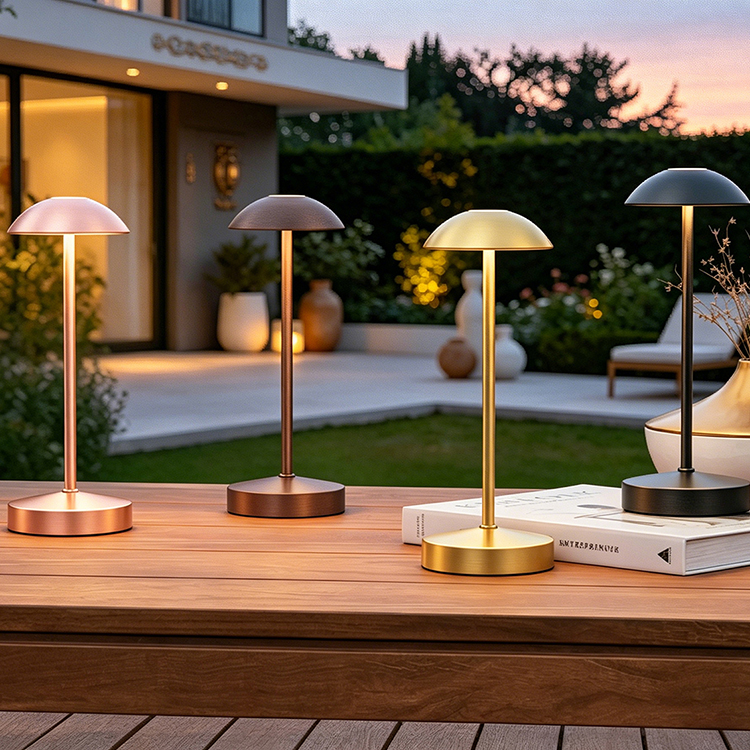
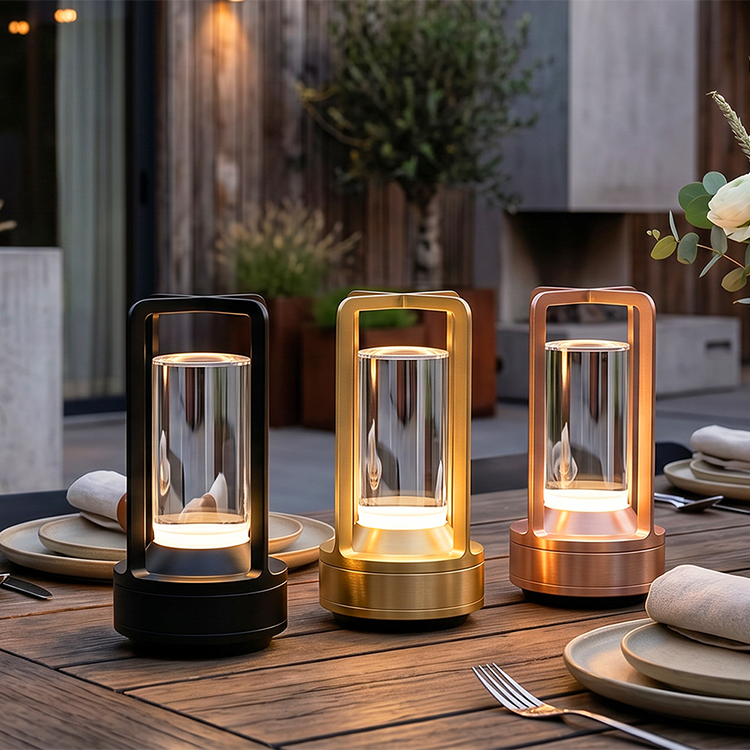
- How Matt Black, Antique Copper, and Antique Bronze shape your restaurant’s identity
- The labor trap: 45 minutes per night your staff spends on lamp duty
- Champagne, salt air, and cleaning chemicals: what actually kills lamps
- The 30-second ambiance audit every owner should do tonight
- Supplier audit checklist: 5 documents to demand before ordering
The Hidden Cost of Choosing Restaurant Table Lamps by Price Alone
A $28 plastic cordless lamp seems like a smart procurement decision until you calculate how many times you will replace it. In a coastal restaurant with salt air, the answer is every three to four months. At a busy downtown bistro with nightly cleaning crews spraying disinfectant on every surface, it is every five to six months.
Over three years, a single table position consumes seven to twelve lamps. The real cost per position is not $28 — it is $200 to $340, plus the labor to unbox, charge-test, and position each replacement. Multiply by 30 tables, and a “budget” lighting decision quietly burns $6,000 to $10,000 in a standard lease cycle.
We engineer restaurant table lamps from machined aluminum alloy and brass because metal does not degrade under UV, does not craze from cleaning chemicals, and does not feel disposable in a guest’s hand. A lamp with the weight of real metal communicates something to your diners before they even sit down: this restaurant cares about objects that last.
For a deeper look at why materials matter, see our breakdown of metal vs. plastic cordless lamps in commercial settings.
2700K — Why Color Temperature Determines Whether Guests Photograph Their Food
Walk into a restaurant lit at 4000K and your brain registers “clinic” before you register “dinner.” The color temperature of your table lighting is the single most overlooked variable in restaurant design, and it directly affects two things: how long guests stay, and whether they post photos of their meal. 2700K — the warm amber spectrum closest to candlelight — does something specific to food. It deepens the reds in a medium-rare steak. It adds warmth to the gold in a white wine glass. It softens skin tones so guests look better in photos, which means they post those photos, which means free marketing for your restaurant.
Every Starvox lamp ships with a fixed 2700K LED array and three brightness levels. We do not offer 4000K or 5000K because in our years of working with Michelin-starred dining rooms and luxury hotel groups, nobody who cares about the dining experience has ever asked for cooler light.
The lamp is not the star of the table — the food is. The light’s job is to make the food look like art and the guest feel like the only person in the room. This is the principle we call light as experience: the fixture disappears, the ambiance takes over.
Matt Black, Antique Copper, or Antique Bronze — How Finish Defines Your Restaurant’s Identity
Most restaurant suppliers treat finish as an afterthought — pick a color, move on. We treat it as the primary visual language your lamps speak to your guests. Each of our three metal finishes carries a distinct spatial narrative.
Matt Black absorbs ambient chaos. In a busy open-kitchen restaurant with movement, noise, and visual clutter, a Matt Black lamp anchors the table without adding to the noise. It is the architectural equivalent of a deep breath — it clears the visual field so the guest focuses on the food and the company.
Antique Copper reflects warmth with the depth of something that has existed for generations. It pairs naturally with leather banquettes, dark wood tables, and wine cellar aesthetics. Over years of service, it develops a natural patina — not a defect, but a record of every dinner service it has witnessed.
Antique Bronze carries the heaviest architectural weight among restaurant table lamps. It reads as grounded, archaeological, permanent. In a restaurant designed to feel like it has been there for a century, Bronze delivers that message without a word. The French designer team behind Starvox spent years refining these finishes to do exactly one thing: make the lamp feel like it belongs to the space, not like it was ordered from a catalog. Read more about our French design approach to hospitality lighting.
The Labor Trap — Why Your Staff Spends 45 Minutes a Night on Lamp Duty
A 50-table restaurant using individual plug-in lamps allocates roughly 60 to 90 minutes of staff labor per day to lamp management. Collect lamps after last seating. Find available outlets — always fewer than you need. Plug in, wait, check charge indicators. Unplug before opening, redistribute across 50 tables.
At an industry loaded labor rate of $22 per hour, that is $8,000 to $12,000 per year spent on a task that adds zero guest value. It is the single most expensive invisible line item in your front-of-house budget.
Our inductive charging trolley replaces the entire workflow with one action: place the lamp on the tray. A standard trolley holds 30 lamps, charges them all in under five hours, and can be rolled through the dining room in a single pass at closing time.
When we deploy this system with new clients, we run a two-week before-and-after time study. The results are consistent: lamp-handling labor drops by 80 to 90 percent, and the trolley pays for itself within four to six months. For a detailed ROI breakdown, see our analysis of how a charging cart saves 10+ labor hours weekly.
Champagne, Salt Air, and Cleaning Chemicals — What Actually Kills Restaurant Table Lamps
Lab durability tests simulate conditions that restaurants laugh at. No test chamber replicates a server knocking a lamp into a champagne bucket at 9 PM on a Saturday. No accelerated aging protocol accounts for the bleach-based cleaning spray that hits every surface in the dining room twice a day.
These are the real-world threats that kill lamps — not “wear and tear,” but impact, chemical exposure, and moisture ingress at the seams.
Our response is not a thicker plastic shell. It is machined metal housings with silicone-gasketed seams, gold-plated charging contacts that resist corrosion from salt air and cleaning agents, and thermally insulated battery compartments that prevent performance loss in direct afternoon sun on a patio.
The outdoor series carries a genuine IP65 rating — dust-tight and protected against water jets from any direction. This is not marketing language. We have units in continuous operation on oceanfront restaurant terraces since 2019, exposed to Pacific salt spray and nightly pressure washing, that have required zero housing or battery replacements. For the engineering distinction between IP54 and IP65, see our IP54 vs. IP65 engineering guide.
The 30-Second Ambiance Audit Every Restaurant Owner Should Do Tonight
Before you spend a dollar on new restaurant table lamps, walk into your dining room during service tonight and answer three questions.
First: can you see the light source, or only the light? If you can see the bare LED or bulb from any seated position, you have glare. Glare makes guests squint, which makes them uncomfortable, which makes them leave earlier and order one less round.
Second: are all your tables the same color? If table seven sits under a cool white bulb and table three sits under warm amber, your room looks like a lighting showroom, not a restaurant.
Third: when you look at a plate of food under your current lights, does it look appetizing? If you would not photograph it, your guests will not either. The right lamp makes itself invisible — you notice the food, the company, the evening. You do not notice the fixture. That is the principle we call silent design.
Refer to the Illuminating Engineering Society (IES) for industry standards on hospitality lighting levels and glare control — the benchmark reference for professional restaurant lighting design.
Supplier Audit Checklist: 5 Documents to Demand Before Ordering Restaurant Table Lamps
- Battery Cycle Test Report — Confirms lithium cell capacity retention across rated charge cycles. A genuine report comes from a third-party lab, not an internal spreadsheet. Without it, you are guessing whether your lamps will still hold a charge after six months of daily use.
- IP Rating Test Certificate — Verifies the enclosure has been independently tested to its claimed ingress protection level. A legitimate IP65 certificate is issued by an accredited testing laboratory, not self-declared. This is non-negotiable for outdoor and coastal restaurant deployments.
- CE / UL / FCC Declaration of Conformity — The legal documents that accompany certified electrical products. Without these, your shipment can be held at customs or rejected by your insurer. Every Starvox order includes the full set with shipment documentation.
- Material Composition Data Sheet — Confirms the alloy grade of metal housings and the type of surface treatment applied. This determines how your lamps will look and perform after two years of daily cleaning and handling — long after the warranty has expired.
- Pre-Shipment Inspection Report — A batch-level quality audit performed before container loading. Should include functional testing of a random sample, not just a visual once-over. We provide this as standard with every commercial order.
We provide all five documents with every order as a matter of standard practice. If a supplier hesitates to share any of them, ask yourself what they are protecting.
A lamp that ships without a battery test report is a lamp that was never tested. A shipment without an IP certificate is a waterproof claim you are taking on faith. Your restaurant’s ambiance deserves better than faith.
Investing in the right restaurant table lamps is not a procurement decision — it is a revenue decision disguised as a lighting decision. Starvox has spent ten years engineering restaurant table lamps for the actual conditions of commercial hospitality — not for a product photo, not for a trade show booth, but for the nightly reality of fine dining service.
Our restaurant table lamps manufacturing partner is a Sam’s Club direct supplier holding a Walmart ID, which means our production lines meet the audit standards of the world’s most demanding retail buyers. Every lamp ships from US commercial stock within seven days of order confirmation, and every order from 36 units up includes our 12-month engineering support commitment. If you are evaluating lighting for a single flagship restaurant or standardizing across a multi-property group, contact our team for a tailored quote with full specification sheets and sample availability.
Modern restaurant tables are moving beyond the cord, and our guide to wireless table lamp design trends explains what to expect next. See how 2700K optics and fleet charging are becoming the new standard.
For properties running 40-plus fixtures across indoor and patio zones, a rechargeable cordless table lamps fleet with inductive charging is the operational upgrade that pays for itself in labor savings.
For venues that rearrange floor plans nightly, a portable table lamp fleet with bulk charging cuts setup time dramatically.
Or email [email protected] for specification sheets, sample requests, and volume pricing.
2 thoughts on “Restaurant Table Lamps: 7 Proven Signs Your Ambiance Is Burning Revenue Every Night”