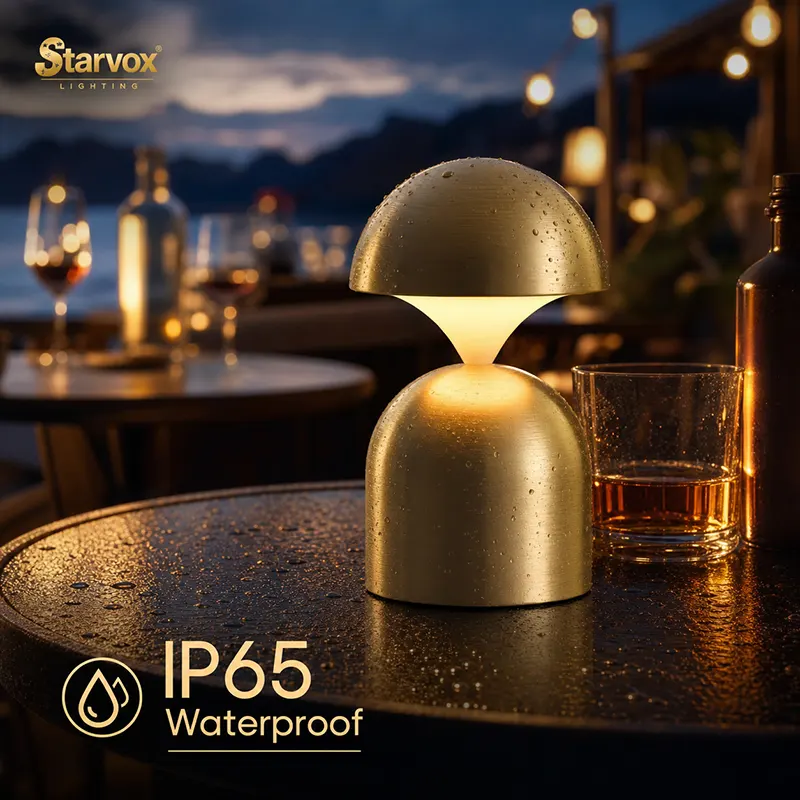
When a restaurant group or boutique hotel chain searches for a cordless table lamp, they are rarely comparing aesthetic catalogues. They are weighing a procurement decision that will impact daily operations, labor allocation, and outdoor dining revenue for years. Yet most of the information available online is written for consumers buying a single bedside lamp — not for hospitality operators deploying 80 units across three oceanfront patios. In our years of engineering and supplying commercial cordless table lamp systems to North American and European hospitality groups, we have identified five non-negotiable factors that separate a genuine commercial-grade unit from a disposable consumer accessory.
Table of Contents
- 1. Build Material: Why a Metal Cordless Table Lamp Outlasts Plastic
- 2. Battery Capacity & Real-World Runtime: Beyond the Spec Sheet
- 3. Waterproof Rating: What IP65 Really Means for Outdoor Dining
- 4. Charging Workflow: The Hidden Labor Cost Multiplier
- 5. Compliance, Warranty & After-Sales: The Supplier Reliability Test
- Supplier Audit Checklist: 5 Documents to Request
- Frequently Asked Questions
1. Build Material: Why a Metal Cordless Table Lamp Outlasts Plastic
The first question every procurement manager should ask is: what is the lamp body made of? In a high-turnover restaurant environment, a cordless table lamp is handled by staff twice per shift — picked up, placed on a charging trolley, returned to tables. Plastic housings develop micro-cracks around the base within months. We have seen hospitality operators replace an entire fleet of plastic cordless lamps three times in a single year, simply because the structural integrity could not survive daily service cycles.
A commercial-grade metal body changes this equation entirely. Our manufacturing process uses precision-cut aluminum and zinc alloy housings with a brushed metallic finish — available in vintage brushed silver and brushed champagne gold — that not only withstands daily handling but improves in character over time. The heft of a metal lamp also provides critical stability on outdoor tabletops where wind gusts are common. When evaluating suppliers, request the material specification sheet: 6063 aluminum alloy with powder-coated surface treatment is the benchmark for hospitality-grade durability.
2. Battery Capacity & Real-World Runtime: Beyond the Spec Sheet
A specification label that reads “4000mAh” tells you nothing about how long a cordless table lamp will actually illuminate a dinner service. Battery capacity must be measured against real-world runtime at usable brightness levels — not at the dimmest eco-mode setting. In restaurant operation, a lamp needs to maintain meaningful ambient light from 6 PM seating through midnight closing, a minimum of six continuous hours at 70-80% brightness.
Our engineering team benchmarked this extensively: a true 5000mAh lithium battery cell, when paired with an efficient LED driver circuit, delivers 60+ hours of continuous runtime at restaurant-appropriate brightness. This means a Friday-to-Sunday service window without recharging — a practical metric that matters far more than the peak-hour claim on a retail box. When auditing a supplier, ask for a time-lapse runtime test video at 75% brightness, not the 10% brightness figure often cited in marketing materials.
Battery lifecycle is the second half of the equation for any cordless table lamp deployed in daily service. Consumer-grade lithium cells degrade to 70% capacity within 300 charge cycles. A restaurant cycling lamps daily hits that threshold in under a year. Commercial-grade cells with thermal management circuitry extend this to 800+ cycles, making the difference between a one-year write-off and a five-year asset. Read our deep dive on commercial battery lifecycle engineering.
For a complete seven-factor evaluation framework, read our guide to battery powered table lamps for commercial deployment. It covers capacity verification, runtime math, and charging infrastructure in one place.
3. Waterproof Rating: What IP65 Really Means for Outdoor Dining
Every coastal restaurant operator has the same story: a shipment of “waterproof” cordless lamps that failed after the first monsoon season. The gap between marketing claims and engineering reality is in the IP (Ingress Protection) rating system. IP54 — the most common rating on consumer cordless lamps — protects against splashing water only. It does not protect against the pressurized water jets used in nightly patio cleaning, nor against the salt-laden humidity that condenses inside lamp housings overnight.
An IP65-rated cordless table lamp is tested against low-pressure water jets from any direction for a minimum of 15 minutes at 12.5 liters per minute. This is the minimum rating we specify for any lamp destined for outdoor hospitality use. Unlike IP54-rated consumer products that only handle splashing, an IP65 lamp survives the pressurized cleaning routines and salt-laden humidity that define real restaurant patio environments.
Our polyester powder coating is applied at 80-100 microns and tested to ISO 9227 neutral salt spray standards, delivering 1,000+ hours of corrosion resistance — conditions that replicate years of seaside exposure in weeks of accelerated testing. For a detailed technical comparison of IP ratings in coastal environments, read our IP54 vs IP65 engineering analysis.
4. Charging Workflow: The Hidden Labor Cost Multiplier
The most expensive component of a cordless table lamp system is not the lamp itself — it is the labor required to keep it charged. A restaurant with 40 outdoor tables using individually charged USB lamps requires staff to collect each unit, locate the matching cable, plug it in, and redistribute before the next service. We have measured this workflow in partner restaurants: 60-90 minutes of server labor per evening, translating to approximately $18,000-$27,000 in annual labor cost at US hospitality wages.
The alternative is inductive bulk charging — a system where multiple lamps charge simultaneously on a single contact pad, loaded onto a mobile trolley. A staff member wheels the trolley through the dining area, collects all lamps in under five minutes, and returns them fully charged before the next service. This workflow reduces nightly lamp-handling labor by over 80%. When evaluating a cordless lamp supplier, ask: does the system include a bulk charging solution, or am I buying individual lamps with individual chargers? The answer determines your total cost of ownership. Calculate your restaurant’s labor savings with our charging cart ROI breakdown.
5. Compliance, Warranty & After-Sales: The Supplier Reliability Test
Electrical products deployed in commercial hospitality settings in North America must carry UL certification. For European markets, CE marking and UKCA compliance are non-negotiable. Yet many online cordless lamp listings display certification logos without verifiable certificate numbers. A legitimate UL listing is searchable in the UL Online Certifications Directory — if a supplier cannot provide their UL file number, the certification claim is unverifiable.
Beyond certification, the warranty structure reveals whether a supplier stands behind their engineering. A 12-month comprehensive warranty with US-based technical support — including replacement units shipped from domestic inventory within days — is the benchmark for commercial-grade suppliers.
Our manufacturing partner holds a Walmart Supplier ID and serves as a direct supplier to Sam’s Club, which means every cordless table lamp we produce passes through a quality management system that has survived retail-level compliance audits most online-only sellers never face. This is the kind of supply-chain transparency that procurement teams at major hospitality groups require as a baseline.
Supplier Audit Checklist: 5 Documents to Request Before Signing a Purchase Order
- Material Specification Sheet — Confirms alloy grade (6063 aluminum minimum for hospitality) and surface treatment process. Without this, you are buying an unknown metal composition.
- IP Test Certificate — An ISO 9227 salt spray test report with documented hours to failure. “IP65” printed on a box is meaningless without the lab report.
- Battery Runtime Test Video — Request a time-lapse recording at 75% brightness, not 10%. This single document exposes inflated battery claims immediately.
- UL File Number / CE Declaration of Performance — Must be verifiable in public certification databases. Accept no screenshot of a certificate alone.
- Pre-Shipment Inspection Report Sample — A recent third-party inspection report from a bulk order demonstrates that quality control is systematic, not anecdotal.
Selecting the right cordless table lamp supplier is ultimately a total-cost-of-ownership decision — not a unit-price comparison. A lamp that saves $15 per unit but requires $25 in annual labor to maintain is not cheaper. We have built our entire product ecosystem around this principle, and we encourage every hospitality buyer to apply the five factors above as a standardized evaluation framework when comparing suppliers.
For the full commercial evaluation framework covering battery, waterproofing, charging infrastructure and compliance, see our commercial cordless lamps buyer’s guide. id=”faq”>Frequently Asked Questions About Commercial Cordless Table Lamps
How long does a commercial cordless table lamp battery last per charge?
A well-engineered commercial unit with a 5000mAh lithium cell delivers 60+ hours at restaurant-appropriate brightness. Consumer models typically achieve 8-12 hours at best. The difference is in the LED driver efficiency and battery cell quality, not just the mAh number.
What is the minimum waterproof rating for outdoor restaurant use?
IP65 is the practical minimum for outdoor dining. IP54 only protects against splashes, not cleaning jets or coastal humidity. For oceanfront properties, IP65 with ISO 9227 salt spray certification is recommended.
Can cordless table lamps be used with bulk charging systems?
Only if the lamp and charging system are designed as an integrated solution. Inductive bulk charging requires compatible contact points on the lamp base. Retro-fitting a USB-charged lamp to a bulk system is not possible — this is a procurement decision, not an aftermarket upgrade.

Refer to the UL Lighting Certification Standards for current North American compliance requirements.
For a look at where the category is heading, read our guide to the 5 smart trends in wireless table lamp design. It shows how 2700K optics, metal materials, and systemized charging are reshaping hospitality.
For a focused look at battery-powered options, read our guide to rechargeable cordless table lamps for commercial use. It covers charging systems, runtime comparison, and total cost of ownership.
Waterproof performance is one of the eight quality factors; our IP54 vs IP65 waterproof guide covers it in detail.
Related reading: weighing the switch? See our full cordless vs wired table lamps breakdown — it covers the infrastructure bill, outdoor IP ratings and the pilot-first rollout.
1 thought on “5 Essential Factors for Evaluating Commercial Cordless Table Lamp Quality”