If you have ever watched a server spend 45 minutes collecting lamps after service, or found half your patio fixtures dead before a Saturday reservation, you know the stakes behind choosing the right rechargeable cordless table lamps.
The difference between a reliable commercial fleet and a disposable consumer batch is not a spec sheet number—it is engineering, build quality, and a charging system that scales. In our decade of supplying cordless lighting to European hospitality groups, we have built a seven-factor framework for evaluating lamps that actually survive daily restaurant and hotel service.
- What to Look for in Commercial Rechargeable Lamps
- Battery Capacity and Real-World Runtime
- Charging Systems: Individual vs. Bulk Solutions
- Build Quality and Material Selection
- Water Resistance and Outdoor Suitability
- Design, Light Quality, and Ambiance
- Compliance and Certifications
- Cost of Ownership and ROI
- Supplier Audit Checklist
- Frequently Asked Questions
What to Look for in Rechargeable Cordless Table Lamps
Not every rechargeable lamp is built for commercial use. A product designed for residential dining will not survive the pickup-and-place cycle of a busy restaurant, nor will it hold a consistent charge through a full service week.
The right unit balances four priorities: runtime, build, charging infrastructure, and light quality. When we work with hospitality buyers, we always start with the operational question before the aesthetic one.
How many tables? Indoor or outdoor? How long is service? The answers shape which fixtures fit the property, not the other way around.
Battery Capacity and Runtime of Rechargeable Cordless Lamps
The mAh number on a product page tells you cell size, not usable runtime. Consumer brands routinely cite runtime at the dimmest setting, which bears no relation to how a restaurant actually uses the lamp.
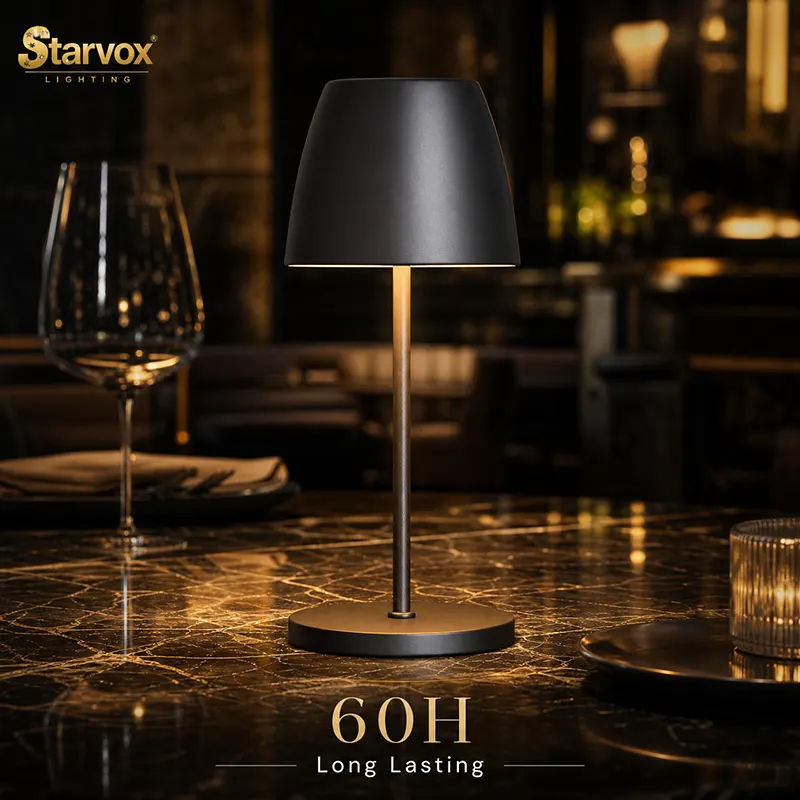
For commercial evaluation, ask for runtime at 75% brightness. That is the level most dining rooms use during peak service. Our Vintage and Dome series use a genuine 5000mAh lithium-ion cell with an efficient LED driver, delivering 60+ hours at service brightness—enough for a full week of dinner service between charges.
Cycle life matters too. A consumer cell degrades to 70% capacity in roughly 300 cycles, which is under a year of daily restaurant use. Commercial-grade cells with thermal management reach 800+ cycles, turning a one-year write-off into a five-year asset.
Charging Systems: Individual USB vs. Bulk Inductive Solutions
The lamp is only half the system. How 40 or 60 fixtures return to full charge every night determines whether your cordless investment saves labor or creates a new nightly chore. Individual USB charging works for a handful of lamps in a small cafe.
Bulk inductive charging trolleys change the economics entirely. A 36-lamp trolley wheels through the dining room, docks every fixture in a single pass, and recharges the full fleet within five hours.
Our partner restaurants measured 60 to 90 minutes of nightly handling labor before switching to bulk charging—and five minutes after. When evaluating rechargeable cordless table lamps for a commercial property, verify that the supplier offers a compatible bulk charging system. We designed our entire rechargeable cordless lamp system around inductive bulk charging for exactly this reason.
Build Quality: Why Metal Construction Matters for Commercial Use
A restaurant lamp gets picked up, docked, wiped down, and repositioned multiple times every service. Plastic bodies crack at the base within months. Threads strip. Finishes peel.
Machined aluminum alloy and brass carry the weight that anchors a lamp on a windy patio and communicate permanence to guests. The heft is not decoration—it is the reason the lamp stays upright when a server brushes past with a tray.
Metal also ages honestly. Antique Copper and Antique Bronze develop a natural patina over years of service, what we call aging gracefully alongside your finest memories. Look for polyester powder coating applied at 80 to 100 microns, tested to ISO 9227 neutral salt spray for 1,000+ hours. Our metal vs. plastic cordless lamps guide covers the durability comparison.
Water Resistance Ratings: IP54, IP65, and What They Actually Mean
Patio service means spills, rain, pressure-washed floors, and salt air. A lamp rated only IP54 for splash resistance will fail within one coastal season. The rating system is often misunderstood, so let us be precise about what each level delivers.
IP65 means dust-tight and protected against low-pressure water jets from any direction—the practical minimum for outdoor dining and patio use. IP54 only resists splashed water, which is insufficient for anything beyond occasional indoor spills.
For oceanfront properties, add ISO 9227 salt spray testing for the coating, measured in hours to failure. When evaluating rechargeable cordless table lamps for outdoor deployment, request the actual test certificate rather than trusting the printed label. Our deep dive into IP54 vs IP65 for outdoor dining walks through the engineering differences.
Design, Light Quality, and the Ambiance Difference
Light is not utility—it is experience. The color temperature, beam pattern, and flicker profile of a lamp shape how food looks, how long guests stay, and how much they spend.
Look for 2700K warm white LEDs—the amber tone closest to candlelight, engineered for the way food and skin look beneath it. A 90+ CRI ensures that the lamp reveals true color rather than washing it out. Three-level dimming gives your floor staff control over the mood.
The fixture itself should disappear into the room. We call it quiet luxury—the lamp recedes and the light takes center stage. Six product lines give designers and operators options: the slim vintage silhouette of the VT-1230, the cinematic dome of the DM-1311, the organic geometry of the MR-1118 Mushroom, the translucent Lucent, the natural marble Stone base, and the compact Cute line for intimate tables.
Compliance and Certifications: UL, CE, FCC, and What to Verify
Certifications are the fastest filter between genuine commercial hardware and imported consumer stock. UL covers North American safety standards, CE and UKCA cover Europe, and FCC covers wireless features like 2.4G remote controls.
A legitimate UL listing carries a file number you can search in a public directory. If a supplier cannot produce the number, the logo on their website is decoration. Same principle applies to CE declarations and FCC IDs—searchable public records are evidence; screenshots are not.
Our full line ships with complete CE, UL, and FCC documentation, and our manufacturing partner holds a Walmart Supplier ID as a direct Sam Club supplier. Read our guide to UL, FCC, and North American compliance for the full landscape.
Cost of Ownership: Why Cheap Rechargeable Lamps Cost More Long-Term
The unit price of a lamp is the smallest part of its five-year cost. The real expenses are replacement cycles, nightly labor, and the revenue impact of dead fixtures during service. A 30-dollar plastic lamp that lasts six months and costs 90 minutes of staff time every night is not a bargain—it is a recurring expense.
A commercial-grade metal lamp with a bulk charging system costs more upfront, but it cuts nightly handling labor by over 80%, lasts five-plus years, and maintains consistent light quality throughout.
For a 40-lamp restaurant operation, the labor savings alone typically pay back the premium within the first year. When comparing quotes, calculate total cost of ownership: unit price times expected replacement frequency, plus estimated nightly labor, plus warranty coverage.
Supplier Audit Checklist: 6 Documents to Request Before Buying
Before you invest in a fleet of rechargeable cordless table lamps, ask your supplier for these six documents. Each one verifies a claim that separates commercial hardware from imported consumer stock.
- Battery Runtime Test Report — Measured at 75% brightness (service level), not at the dimmest setting. Includes cycle life data.
- IP65 Test Certificate — Dust-tight and water-jet protection confirmed by an accredited laboratory, not by a printed label.
- ISO 9227 Salt Spray Report — Documents coating hours to failure, critical for coastal or outdoor deployments.
- UL File Number / CE Declaration — Searchable in public certification databases; screenshots are not evidence.
- Bulk Charging System Compatibility — Confirm that the lamps work with a trolley or pad system before you commit.
- Warranty and Support Terms — 12-month commercial warranty with domestic support is the baseline for fleet purchases.
For the full commercial evaluation framework covering battery, waterproofing, charging infrastructure and compliance, see our commercial cordless lamps buyer’s guide. id=”faq” class=”wp-block-heading”>Frequently Asked Questions About Rechargeable Cordless Table Lamps
How long do rechargeable cordless table lamps last on a single charge?
A well-engineered commercial unit with a true 5000mAh cell runs 60+ hours at restaurant brightness — a full week of dinner service. Consumer models typically manage 8 to 12 hours at best because their capacity claims are measured at the dimmest setting. Always ask suppliers for a runtime test at 75% brightness.
Can I charge multiple rechargeable cordless table lamps at the same time?
Yes, with a bulk inductive charging system. Contact charging trolleys dock 24 to 36 lamps in a single pass and return them to full charge in under five hours, cutting nightly handling labor by over 80%. Individual USB chargers do not scale past a handful of fixtures.
Are rechargeable cordless table lamps safe for outdoor restaurant patios?
Yes, if the unit is IP65-rated and its coating passes ISO 9227 salt spray testing. IP54 only resists splashes and will fail under pressure washing or coastal humidity. For oceanfront properties, insist on IP65 with documented salt spray hours.
What is the lifespan of rechargeable cordless table lamp batteries?
Consumer-grade cells degrade to 70% capacity in roughly 300 cycles — under a year of daily restaurant use. Commercial-grade cells with thermal management reach 800+ cycles, turning a one-year write-off into a five-year asset. Check the cycle rating, not just the headline mAh number.
How do I choose the right rechargeable cordless table lamps for my restaurant?
Start with your operational reality: number of tables, indoor vs. outdoor mix, service hours per week, and existing decor style. Then evaluate six factors: battery runtime at service brightness, build material and coating quality, water resistance rating, bulk charging compatibility, certification documentation, and total cost of ownership. Our cordless table lamp buying guide covers the full evaluation framework.
For current North American safety standards, refer to the UL Lighting Certification Standards. Verify every file number before you place an order—certificates are only as strong as the laboratory behind them.
Choosing rechargeable cordless table lamps for a commercial property is an operational decision as much as a design one. The right fleet pays itself back through labor savings, longer service life, higher guest satisfaction, and a better ambiance that increases average check size.
Use the framework above to screen suppliers, ask for the six audit documents, and evaluate total cost of ownership rather than unit price alone. The apparently cheap option is rarely the cheapest one when you account for everything that happens after the purchase order is signed.
For properties that need maximum flexibility between indoor and outdoor zones, a portable table lamp with trolley charging is the operational upgrade that pays back fastest in labor savings.
If you are specifically evaluating battery-powered models, our battery powered table lamps buyers guide breaks down runtime and charging considerations.
For buyers extending this decision to restaurant groups and private clubs, our rechargeable table lamps for restaurants selection guide explains how to match Dome and Mushroom designs to service rotation, battery capacity, and charging workflow.
3 thoughts on “5 Critical Factors for Choosing Rechargeable Cordless Table Lamps”